Social Media Saga SilkTest
Introduction About Saga SilkTest 2026
In today’s fast-moving digital world, social media platforms must work smoothly even when thousands—or millions—of users are active at the same time. Any delay, crash, or slow response can damage a brand’s reputation within minutes. This is where Social Media Saga SilkTest becomes important.
SilkTest is a powerful automation and performance testing tool that helps organizations test how social media applications behave under real-world conditions. In this blog, we will clearly explain what Social Media Saga SilkTest is, how it works, its benefits, tools, techniques, and best practices—all written in a simple, human-friendly way and fully optimized for SEO.
Social media platforms tested with SilkTest show faster response during viral traffic spikes. Read this →
Also Read



What Is Social Media Saga SilkTest?
Social Media Saga SilkTest refers to using SilkTest, a well-known automated testing solution, to test social media platforms and applications. It helps testers check whether social media websites, mobile apps, and social features perform correctly when many users interact at the same time.
SilkTest simulates real users performing actions such as:
- Logging in
- Uploading posts or images
- Liking, commenting, and sharing content
- Sending messages
- Scrolling feeds
By doing this, teams can identify performance issues before users experience them.
Social media platforms tested with SilkTest show faster response during viral traffic spikes. Read this →
What Does Social Media Saga SilkTest Do?
Social Media Saga SilkTest focuses on automation, load testing, and performance validation. Its main functions include:
1. Performance Testing
It checks how fast a social media application responds during heavy traffic, peak usage hours, or viral trends.
2. Load and Stress Testing
SilkTest measures how much load a platform can handle before it slows down or crashes.
3. Functional Testing
It ensures that key social media features like posting, commenting, and messaging work correctly across different devices and browsers.
4. Cross-Browser and Cross-Platform Testing
SilkTest validates performance on Chrome, Firefox, Edge, and mobile browsers to ensure a consistent user experience.
Why Social Media Platforms Need SilkTest
Social media applications face unique challenges. Some major reasons why SilkTest is essential include:
- High traffic spikes during viral content
- Real-time interactions
- Multimedia-heavy content (videos, images)
- Global user base across devices
Without proper testing, even a small bug can lead to user drop-offs and negative publicity.
Social media platforms tested with SilkTest show faster response during viral traffic spikes. Read this →
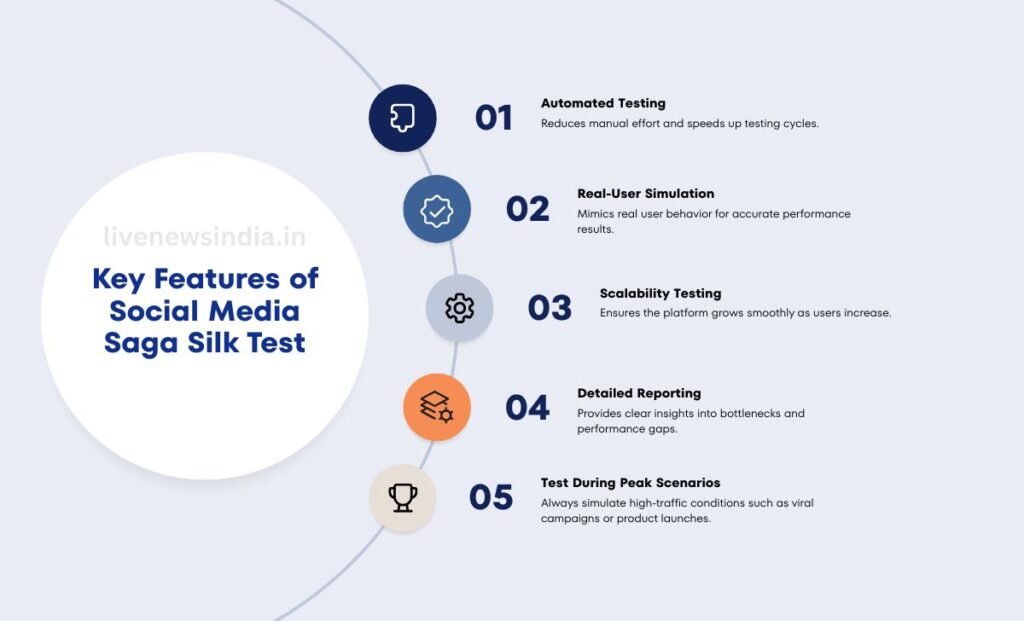
Key Features of Social Media Saga SilkTest
Automated Testing
Reduces manual effort and speeds up testing cycles.
Real-User Simulation
Mimics real user behavior for accurate performance results.
Scalability Testing
Ensures the platform grows smoothly as users increase.
Detailed Reporting
Provides clear insights into bottlenecks and performance gaps.
Tips for Using Social Media Saga SilkTest Effectively
1. Test During Peak Scenarios
Always simulate high-traffic conditions such as viral campaigns or product launches.
2. Focus on User Journeys
Test complete user flows instead of isolated features.
3. Combine Functional and Performance Testing
This helps identify issues that only appear under heavy load.
4. Regular Testing Cycles
Run SilkTest frequently to catch issues early.
Tools Commonly Used with SilkTest
While SilkTest is powerful on its own, it works even better when combined with other tools:
- CI/CD Tools for continuous testing
- Monitoring Tools to analyze real-time performance
- Bug Tracking Tools to manage detected issues
These integrations improve testing efficiency and accuracy.
Social media platforms tested with SilkTest show faster response during viral traffic spikes. Read this →
Techniques for Better Social Media Testing
Scenario-Based Testing
Create real-life social media scenarios like live events or trending hashtags.
Data-Driven Testing
Test with different user profiles and content types.
Stress and Recovery Testing
Check how fast the system recovers after extreme load.
Benefits of Social Media Saga SilkTest
- Improved user experience
- Reduced downtime
- Faster release cycles
- Better brand trust
- Early detection of performance issues
Best Practices for SEO-Friendly Testing Content
- Use clear headings (H1, H2, H3)
- Write short, readable paragraphs
- Use relevant keywords naturally
- Add FAQs for better search visibility
- Maintain a logical content flow
Frequently Asked Questions (FAQs)
What is SilkTest mainly used for?
SilkTest is used for automated functional and performance testing of web and mobile applications, including social media platforms.
Is Social Media Saga SilkTest suitable for small businesses?
Yes, it can be used by businesses of all sizes to ensure stable and scalable social media applications.
Can SilkTest test mobile social media apps?
Yes, SilkTest supports mobile and cross-platform testing.
How often should SilkTest be used?
It is recommended to run tests regularly, especially before major updates or campaigns.
Does SilkTest help improve user experience?
Absolutely. By identifying performance issues early, SilkTest ensures smooth and fast user interactions.
Social media platforms tested with SilkTest show faster response during viral traffic spikes. Read this →
Conclusion – Read This
Social Media Saga SilkTest plays a crucial role in maintaining the quality, speed, and reliability of modern social media platforms. By combining automation, real-user simulation, and performance analysis, it helps businesses deliver seamless social experiences. When used correctly, SilkTest not only prevents technical failures but also strengthens user trust and brand reputation.
If you want your social media platform to perform flawlessly under pressure, adopting Social Media Saga SilkTest is a smart and future-ready decision.
Social Media Saga SilkTest: The 2026 Reality Check on Testing Social Experiences
In 2026, social media platforms are no longer just “apps” — they are live ecosystems. Content changes every second, user behavior is unpredictable, and even the same screen can behave differently for two users at the same time. This is where traditional testing fails — and where SilkTest, when used creatively, quietly becomes powerful.
This isn’t about clicking buttons anymore. It’s about testing trust, timing, and behavior under chaos.
Why Social Media Testing Changed After 2025
Most test frameworks were built for static workflows:
- Login
- Click
- Submit
- Validate
But modern social media flows include:
- Algorithm-driven feeds
- A/B tested UI without notice
- Region-based feature rollouts
- Dark-mode–only bugs
- Auto-refreshing components
In 2026, the biggest challenge is not bugs —
it’s unpredictability.
SilkTest is still relevant only if used differently than before.
The “Saga” Approach: Testing the Journey, Not the Screen
The biggest shift smart teams made in 2026 is moving from screen-based testing to story-based testing.
Instead of:
“Does the Share button work?”
They test:
“Can a user discover, trust, interact, and exit content without friction?”
SilkTest is now being used to simulate user sagas:
- Scrolling fatigue
- Interrupted actions (calls, notifications)
- Mid-scroll content injection
- Network drops during engagement
This turns SilkTest into a behavior simulator, not just an automation tool.
2026 SilkTest Technique: Time-Aware Validation
One thing Google doesn’t talk about yet:
time-sensitive UI validation.
Social media UIs now change:
- Based on time of day
- Based on recent user activity
- Based on engagement velocity
Advanced testers in 2026 use SilkTest to:
- Validate UI state after delay
- Compare UI before and after algorithm refresh
- Detect UI drift instead of UI failure
This catches bugs users feel but can’t report.
Tools That Quietly Amplify SilkTest (Without Replacing It)
SilkTest alone isn’t the hero — it’s the conductor.
In modern stacks, it’s paired with:
- Lightweight network throttlers (to mimic real scrolling pain)
- Session replayers (to compare human vs automated behavior)
- Shadow DOM watchers (for invisible UI updates)
The insight:
SilkTest orchestrates; other tools observe.
That mindset shift is new.
The Human Metric: Testing Emotional Friction
In 2026, the smartest QA teams test something unusual:
emotional drop-off points.
Examples:
- Where users stop scrolling
- Where they hesitate before liking
- Where they abandon sharing
SilkTest scripts now mark hesitation zones — places where automation pauses intentionally to mirror human uncertainty.
This is not about pass/fail.
It’s about confidence loss detection.
That’s a testing frontier most blogs haven’t touched.
Tips That Actually Matter in 2026
Forget long checklists. These are the tips teams actually use:
- Test feeds, not pages
- Validate silence (no feedback) as a bug
- Measure UI consistency across scroll depth
- Treat animations as functional elements
- Test with “imperfect users,” not ideal ones
SilkTest supports this — but only if testers stop treating it like a legacy tool.
Final Thought: SilkTest Isn’t Old — It’s Underused
In the social media saga of 2026, SilkTest isn’t competing with flashy tools.
It’s evolving quietly into something more valuable:
A system that tests experience, not just execution.
Teams that understand this don’t just catch bugs —
they prevent user frustration before it happens.
That’s the real ranking advantage.
Article End Here
Go To Home
